
Team and Player Possession#
Knowing which team has possession at a certain point provides crucial information about the match. Of course, the overall ball possession is interesting, but seeing this ball possession over time might be more intuitive. On top of that, you can combine this data with the ball data to see where the team has most possession of the ball for furhter analysis. Besides team possession, you might be more interesting in individual player possession. You might now know when a player is involved in an event, but unaware if this player took a lot of time to perform this event, or if he was forced to do so. Besides, you can combine individual player possession with pressure to see which player handle pressure the best/worst.
Warning
Although we try to keep everything up to date, the code in this notebook might not perfectly align with the code in the package. If you find any bugs or have any suggestions, please let us know.
Team Possession#
Some tracking data providers, like Tracab, provide info about which team has possession of the ball during the match. You could sometimes question the accuracy of this data but at least it is a good place to get started with. However, this is not the case for all data providers. By combining the tracking and event data, you can make a calculated guess about which team has possession of the ball. For instance, if the home team performs a successfull pass at frame 0, you can be quite certain that the home team is in ball possession. This possession probably holds untill the other team makes a successful on-ball event (pass, dribble, shot). Lets see how we can compute this in some code.
import pandas as pd
from databallpy.utils.constants import MISSING_INT

def add_team_possession(
    tracking_data: pd.DataFrame,
    event_data: pd.DataFrame,
    home_team_id: int,
    inplace: bool = False,
) -> None | pd.DataFrame:
    """Function to add a column 'ball_possession' to the tracking data, indicating
    which team has possession of the ball at each frame, either 'home' or 'away'.

    Args:
        tracking_data (pd.DataFrame): Tracking data for a match
        event_data (pd.DataFrame): Event data for a match
        home_team_id (int): The ID of the home team.
        inplace (bool, optional): Whether to modify the DataFrame in place.
            Defaults to False.

    Returns:
        None | pd.DataFrame: The tracking data with the 'ball_possession' column added.
    """
    if not inplace:
        tracking_data = tracking_data.copy()

    on_ball_events = ["pass", "dribble", "shot"]
    current_team_id = event_data.loc[event_data["databallpy_event"].isin(on_ball_events), "team_id"].iloc[0]
    start_idx = 0
    tracking_data["ball_possession"] = None
    for event_id in [x for x in tracking_data.event_id if x != MISSING_INT]:
        event = event_data[event_data.event_id == event_id].iloc[0]

        if (
            event["databallpy_event"] in on_ball_events
            and event.team_id != current_team_id
            and event.outcome == 1
        ):
            # Switch of teams
            end_idx = tracking_data[tracking_data.event_id == event_id].index[0]
            team = "home" if current_team_id == home_team_id else "away"
            tracking_data.loc[start_idx:end_idx, "ball_possession"] = team

            current_team_id = event.team_id
            start_idx = end_idx

    last_team = "home" if current_team_id == home_team_id else "away"
    tracking_data.loc[start_idx:, "ball_possession"] = last_team

    if not inplace:
        return tracking_data
Note
Looping over all events is of course not a computational fast way of doing this. However, the code still runs reasonably fast and it makes a clear example of how this function works. If you have any suggestions on how to change this code, please check the back-end code and open a pull request to vecotorize the computations.
In summary, we assume the team that has possession is the team that has done the last on-ball event. Now, there are a lot of nuances that are ignored in this oversimplistic function:
When a team gets possession, but the first event is not successful, they are not rewarded any possession. There is a choice here, either you give them possession even though they might not actually have had possession, or you only award a possession when there was at least 1 successfull event.
We are highly dependent on the quality of the event data and the synchronisation of tracking and event data for this function to work well. An assumption that might be violated by times.
The exact definition of team possession is not always clear, especially in ground and arieal duels, this of course influences the final result.
Having said all this, I think this is a valid point to get started for your analysis if the tracking data does not provide the team possession information in their data
Team Possession in DataBallPy#
In DataBallPy you can import the add_team_possession function from the features module.
from databallpy import get_match, get_open_match

match = get_match(
  tracking_data_loc="../data/tracking_data.dat",
  tracking_metadata_loc="../data/tracking_metadata.xml",
  tracking_data_provider="tracab"
  event_data_loc="../data/event_data_f24.xml",
  event_metadata_loc="../data/event_metadata_f7.xml",
  event_data_provider="opta",
)

# or get the open match provided by Metrica
match = get_open_match()
Note
The current supported tracking data providers are:
Tracab
Metrica
Inmotio
The current supported event data provider are:
Opta
Metrica
Instat
If you wish to use a different provider that is not listed here, please open an issue here
from databallpy.features import add_team_possession

match.tracking_data.rename(columns={"ball_possession": "ball_possession_original"}, inplace=True)

# Synchronise your match if you have not done that yet:
# >>> match.synchronise_tracking_and_event_data()

add_team_possession(match.tracking_data, match.event_data, match.home_team_id, inplace=True)

print("Difference between tracking data and event-data based approach:")
print(
    match.tracking_data.loc[
        match.tracking_data["ball_status"]=="alive", ["ball_possession", "ball_possession_original"]
        ].value_counts()
)

print("\nFirst period where both approaches do not align:")
td_alive = match.tracking_data.loc[match.tracking_data["ball_status"]=="alive"]
print(
    td_alive[(td_alive["ball_possession"]=="home") & (td_alive["ball_possession_original"] == "away")].index[:100]
)
Difference between tracking data and event-data based approach:
ball_possession  ball_possession_original
home             home                        3613
away             away                        1684
home             away                         320
away             home                         275
Name: count, dtype: int64

First period where both approaches do not align:
Index([ 859,  860,  861,  862,  863,  864,  865,  866,  867,  868,  869,  870,
        871,  872,  873,  874,  875,  876,  877,  878,  879,  880,  881,  882,
        883,  884,  885,  886,  887,  888,  889,  890,  891,  892,  893,  894,
        895,  896,  897,  898,  899,  900,  901,  902,  903,  904,  905,  906,
        907,  908,  909,  910,  911,  912,  913,  914,  915,  916,  917,  918,
        919,  920,  921,  922,  923,  924,  925,  926,  927,  928,  929,  930,
        931,  932,  933,  934,  935,  936,  937,  938,  939,  940,  941,  942,
        943,  944,  945,  946,  994,  995,  996,  997,  998,  999, 1000, 1001,
       1002, 1003, 1004, 1005],
      dtype='int64')
Looks like both approaches generally align, but from frame 151 untill 300 (~6 seconds) there are some differences. The event-data based approach thinks the home team has ball possession, while the tracking data provider indicates that the away team has ball possession. Generally, there are 2 things that could be going on:
The tracking data is wrong here. Tracking data is often acquired semi-automatically, and somethimes columsn like team possession are not switched as expected.
The synchronisation of tracking and event data did not go well, or the event/tracking data has substantial errors.
The definition of a ball possession does not align between our approach and that of the tracking data provider.
Lets visualize a match clip to see what is going on in this instance.
start_idx = 700
end_idx = 1250

print(
    match.event_data[
    (match.event_data["minutes"]==0) &
    (match.event_data["seconds"].between(start_idx/match.frame_rate - 2, end_idx/match.frame_rate + 2)) &
    (~pd.isnull(match.event_data["databallpy_event"]))
    ][["databallpy_event", "player_name", "outcome"]]
)
   databallpy_event player_name  outcome
15             pass      home_3        1
16             pass     home_10        1
22             pass      away_8        0
23             pass      home_5        0
from databallpy.visualize import save_tracking_video

save_tracking_video(
    match,
    start_idx,
    end_idx,
    os.path.join(os.getcwd(), "../static"),
    title="team_possession_difference",
    events=["pass", "dribble", "shot"],
    variable_of_interest=match.tracking_data.loc[start_idx:end_idx, "frame"]
)
Explaining the difference#
So we can see that the tracking data provider gives ball possession to the away (red) team from frame 859 untill at least 1005, while the event-data based approach gives this period to the home (green) team. Close to frame 859, away 8 performs a (unsuccessful) pass. Tracab seems to account this as a possession for the away team, while the current approach only acknowlegdes a switch in ball possession after a successful event. This it thus a difference in definition of ball possession. Interstingly, when home 5 performs an unsuccessful pass afterwards, the tracking data provider does not account this possession to the home team. It looks like somewhere there was a foul made, it is not exactly clear when this happens relatively to the passes, which might explain why the tracking provider did not switch the ball possession here.
Conclusion#
However, overall, it seems like the event-based approach does corroberate with what the tracking data provides as indication of team possession. So, if you do not have any info of the tracking data regarding ball possession, or have reasong to suspect it is not that accurate, you can use this function from DataBallPy to compute it in a more algorithmic approach.
Individual Player Possession (Vidal-Codina et al. (2022))#
For the individual player possession we will look at an approach introduced by Vidal-Codina et al. (2022): “Automatic Event Detection in Football Using Tracking Data”. Although the overall idea of the paper is not to calculate which player has possession of the ball, it is an important preprocessing step for the machine learning they use afterwards. The approach uses only tracking data (x, and y coordinates) to assign which player has possession for each frame. Generally, the approach uses 3 different steps to find out how long a player was in ball possession:
Did the ball reach the player zone (PZ) of the player?
Did the player actually obtain possession the ball in this periods?
When did the player loose possession of the ball afterwards?
1. The Possession Zone (PZ)#
The possession zone is simply a constant. Once a player is within \(PZ_{radius}\) meters of player \(i\), a potential possession is awarded. If this condition is true for two players of the same team, the possession is awarded to the closest player. If this condition true for two players of the opposite team, it is assigned as a duel, but that it out of the scope of this notebook.
import numpy as np

def get_distance_between_ball_and_players(tracking_data: pd.DataFrame) -> pd.DataFrame:
    """
    Optimized function to calculate the distances between the ball and all players using vectorized operations.

    Args:
        tracking_data (pd.DataFrame): DataFrame with tracking data over which to calculate the distances.

    Returns:
        pd.DataFrame: DataFrame with the distances between the ball and all players.
    """

    player_columns = [col for col in tracking_data.columns if "_x" in col and "ball" not in col]
    ball_x, ball_y = tracking_data["ball_x"].values, tracking_data["ball_y"].values

    distances_df = pd.DataFrame(index=tracking_data.index)
    for col in player_columns:
        player_x, player_y = tracking_data[f"{col}"].values, tracking_data[f"{col[:-2]}_y"].values
        distances = np.sqrt((ball_x - player_x) ** 2 + (ball_y - player_y) ** 2)
        distances_df[col[:-2]] = distances

    return distances_df

def get_initial_possessions(
    tracking_data: pd.DataFrame,
    pz_radius: float,
    distances_df: pd.DataFrame = None,
) -> pd.Series:
    """
    Calculate initial ball possession based on proximity and duration within the possession zone (PZ).

    Args:
        tracking_data (pd.DataFrame): Tracking data with player positions.
        pz_radius (float): Radius of the possession zone in meters.
        distances_df (pd.DataFrame, optional): DataFrame with distances between the ball and players.
            Defaults to None.

    Returns:
        pd.Series: Player possession status for each frame.
    """
    if not distances_df:
        distances_df = get_distance_between_ball_and_players(tracking_data).fillna(np.inf)
    closest_player = distances_df.idxmin(axis=1, skipna=True)
    close_enough = distances_df.min(axis=1) < pz_radius
    return np.where(close_enough, closest_player, None)

initial_possession = get_initial_possessions(match.tracking_data, 1.5)
print(initial_possession)
['away_6' 'away_6' 'away_6' ... None 'home_2' 'home_2']
For every frame we have now calculated which player is closest to the ball, and if that player is within the \(PZ_{radius}\) of the ball, we can say that player has potential possession of the ball. Seems like the away team had the kick off, and away_6 took it. Lets continue to the next step to see if this player actually has possession of the ball.
2. Ball Controll#
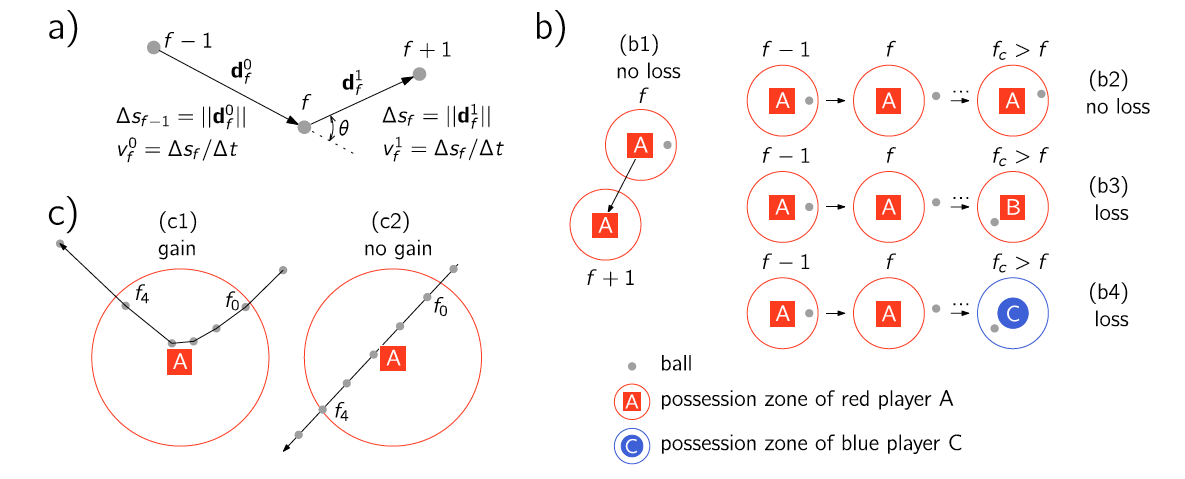
The first condition is not enough to find if a player has valid ball possession. For instance, if the ball flies over a player, that player did not have possession of the ball, although it might look like it on the tracking data. The athors proposed 2 conditions that could see if the player had actuall possession of the ball.
The ball changes from direction while in the possession zone of player \(i\)
The ball changes in speed while in teh possession zone of player \(i\)
Two new constants are added for this: \(BA_{threshold}\) and \(BV_{threshold}\). Here \(BA_{threshold}\) stands for the ball angle, so the difference in direction, and \(BV_{threshold}\) for ball velocity, so the change in speed of the ball. See also the image (C) below for a visual representation of the method.
from databallpy.features import get_smallest_angle

def get_valid_gains(
    tracking_data: pd.DataFrame,
    possession_start_idxs: np.ndarray,
    possession_end_idxs: np.ndarray,
    bv_threshold: float,
    ba_threshold: float,
    min_frames_pz: int,
) -> np.ndarray:
    """Function to check if, within a given period, a player gains possession of the
    ball. Possession is gained if the ball speed changes at least bs_threshold m/s or
    the ball changes direction (> ba_threshold) between the first and the last
    proposed possession frame.

    Args:
        tracking_data (pd.DataFrame): pandas df with tracking data over which to
            calculate the player possession.
        possession_start_idxs (np.ndarray): array with the starting indexes of the
            proposed possessions.
        possession_end_idxs (np.ndarray): array with the ending indexes of the proposed
            possessions.
        bv_threshold (float): minimal velocity change of the ball to gain possession
        ba_threshold (float): minimal angle change of the ball to gain possession
        min_frames_pz (int): minimal number of frames the ball has to be in the possession
            zone to be considered as a possession.

    Returns:
        np.ndarray: array with bools with if the player gained possession of the ball
        per possession.
    """

    ball_angle_condition = get_ball_angle_condition(
        tracking_data, possession_start_idxs, possession_end_idxs, ba_threshold
    )

    ball_speed_condition = get_ball_speed_condition(
        tracking_data, possession_start_idxs, possession_end_idxs, bv_threshold
    )

    min_frames_condition = possession_end_idxs - possession_start_idxs >= min_frames_pz

    return np.logical_and(min_frames_condition, np.logical_or(ball_angle_condition, ball_speed_condition))

def get_start_end_idxs(pz_initial: np.ndarray) -> tuple[np.ndarray, np.ndarray]:
    """Function to get the starting and ending indexes of the proposed possessions
    based on the initial possession of the ball. The proposed possessions are periods
    where the possession of the ball changes.

    Args:
        pz_initial (np.ndarray): The initial possession of the ball.

    Returns:
        tuple[np.ndarray, np.ndarray]: The starting and ending indexes of the proposed possessions.
    """

    shifting_idxs = np.where(pz_initial[:-1] != pz_initial[1:])[0]
    shifting_idxs = np.concatenate([[-1], shifting_idxs, [len(pz_initial) - 1]])

    possession_start_idxs = shifting_idxs[:-1] + 1
    possession_end_idxs = shifting_idxs[1:]

    none_idxs = np.where(pz_initial[possession_start_idxs] is None)[0]
    possession_start_idxs = np.delete(possession_start_idxs, none_idxs)
    possession_end_idxs = np.delete(possession_end_idxs, none_idxs)

    return possession_start_idxs, possession_end_idxs

def get_ball_speed_condition(
    tracking_data: pd.DataFrame,
    possession_start_idxs: np.ndarray,
    possession_end_idxs: np.ndarray,
    bv_threshold: float,
) -> np.ndarray:
    """Function to check if, within the pz zone period, the ball changes speed
    enough to count as a possession gain based on the ball speed condition.

    Args:
        tracking_data (pd.DataFrame): Tracking data with player positions.
        possession_start_idxs (np.ndarray): The starting indexes of the proposed possessions.
        possession_end_idxs (np.ndarray): The ending indexes of the proposed possessions.
        bv_threshold (float): The threshold for the ball speed condition in m/s.

    Returns:
        np.ndarray: Array with bools indicating if the ball speed condition is met
            for each proposed possession.
    """
    ball_speed_change = tracking_data["ball_velocity"].diff().abs() > bv_threshold
    intervals = [
        (start, end) for start, end in zip(possession_start_idxs, possession_end_idxs)
    ]

    # Prevent index out of bounds
    if intervals[-1][1] == tracking_data.index[-1]:
        intervals[-1] = (intervals[-1][0], intervals[-1][1] - 1)

    return np.array(
        [np.any(ball_speed_change[start : end + 1]) for start, end in intervals]
    )

def get_ball_angle_condition(
        tracking_data: pd.DataFrame,
        possession_start_idxs: np.ndarray,
        possession_end_idxs: np.ndarray,
        ba_threshold: float,
) -> np.ndarray:
    """Function to check if, within the pz zone period, the ball changes direction
    enough to count as a possession gain based on the ball angle condition.

    Args:
        tracking_data (pd.DataFrame): Tracking data with player positions.
        possession_start_idxs (np.ndarray): The starting indexes of the proposed possessions.
        possession_end_idxs (np.ndarray): The ending indexes of the proposed possessions.
        ba_threshold (float): The threshold for the ball angle condition in degrees.

    Returns:
        np.ndarray: Array with bools indicating if the ball angle condition is met
            for each proposed possession.
    """
    start_idxs_plus_1 = np.clip(possession_start_idxs + 1, 0, tracking_data.index[-1])
    end_idxs_minus_1 = np.clip(possession_end_idxs - 1, 0, tracking_data.index[-1])

    incomming_vectors = (
        tracking_data.loc[start_idxs_plus_1, ["ball_x", "ball_y"]].values
        - tracking_data.loc[possession_start_idxs, ["ball_x", "ball_y"]].values
    )

    outgoing_vectors = (
        tracking_data.loc[possession_end_idxs, ["ball_x", "ball_y"]].values
        - tracking_data.loc[end_idxs_minus_1, ["ball_x", "ball_y"]].values
    )
    ball_angles = get_smallest_angle(
        incomming_vectors, outgoing_vectors, angle_format="degree"
    )

    return ball_angles > ba_threshold


possession_start_idxs, possession_end_idxs = get_start_end_idxs(initial_possession)
valid_gains = get_valid_gains(
    match.tracking_data, possession_start_idxs, possession_end_idxs, 5., 10., 0
)
print(valid_gains)
[ True  True  True  True  True  True False False False False False False
  True  True  True  True  True  True  True  True False  True False  True
  True  True  True False False False False  True  True  True  True  True
  True False False  True False False False False False False False False
  True  True  True  True  True  True False False  True  True  True  True
  True False  True False  True False  True False  True False  True False
  True False  True False  True False  True  True  True False  True False
  True  True False False  True False  True  True  True False  True  True
 False False  True False  True False  True  True False  True  True  True
  True False False  True False  True False False False False False False
 False False  True False  True  True False  True  True  True False  True
 False False False False  True False  True  True  True False  True False
 False False  True False  True False  True False  True False  True  True
 False  True  True False False False  True False  True False  True False
  True False  True False  True False  True  True  True False  True False
  True False False  True  True  True  True False  True  True False False
  True  True False False  True  True  True  True False False False False
 False False  True False  True  True False  True  True False False False
 False False False  True False False  True  True  True  True  True False
  True  True  True False  True False  True  True False False False False
 False False  True  True  True  True False  True  True  True False  True
  True  True False  True False  True False  True False  True  True  True
 False  True False  True False False  True  True False  True False False
  True  True False False False  True  True  True False  True False  True
 False  True  True False]
/tmp/ipykernel_1902/518216793.py:63: DeprecationWarning: Calling nonzero on 0d arrays is deprecated, as it behaves surprisingly. Use `atleast_1d(cond).nonzero()` if the old behavior was intended. If the context of this warning is of the form `arr[nonzero(cond)]`, just use `arr[cond]`.
  none_idxs = np.where(pz_initial[possession_start_idxs] is None)[0]
For all the proposed possessions, we now know whether the player really had possession of the ball, not just the ball flying over or by the player. Lets go to the last step to see when the player looses possession of the ball.
3. Ball Loss#
Generally, you can say, when the ball leaves the PZ of player \(i\), he looses possession of the ball. There is, however, 1 special case in which this may not be true. If a player has controll of the ball, and starts sprinting with the ball, the ball may leave the possession zone of the player, but it generally feels like that player still has possession of the ball. Therefore, the full period (also where the ball is not within the PZ of player \(i\)) is awarded to possession of player \(i\). See also the image (B) above for a visual representation of the method.
Computationally, we will loop over all valid ball possession gains. For each gain, we will check the period between the start of the gain, and the start of the next gain. The ball possession of player \(i\) is then awarded up and untill the last frame in this period where the ball is within the PZ of player \(i\).
from databallpy.utils.constants import MISSING_INT

def get_ball_losses_and_updated_gain_idxs(
        possession_start_idxs: np.ndarray,
        possession_end_idxs: np.ndarray,
        valid_gains: np.ndarray,
        initial_possession: np.ndarray,
) -> tuple[np.ndarray, np.ndarray]:
        """ Function to get the ball losses and updated gain indexes based on the
        initial possession of the ball.

        Args:
                possession_start_idxs (np.ndarray): The starting indexes of the proposed possessions.
                possession_end_idxs (np.ndarray): The ending indexes of the proposed possessions.
                valid_gains (np.ndarray): The valid gains of the ball.
                initial_possession (np.ndarray): The initial possession of the ball.

        Returns:
                tuple[np.ndarray, np.ndarray]: The starting indexes of the valid gains and the ball losses.
        """
        valid_gains_start_idxs = possession_start_idxs[valid_gains]
        initial_ball_losses_idxs = possession_end_idxs[valid_gains]
        ball_losses_idxs = np.full(len(valid_gains_start_idxs), MISSING_INT, dtype=int)
        last_player = None

        for i, (start, end) in enumerate(zip(valid_gains_start_idxs, initial_ball_losses_idxs)):
            player = initial_possession[start]
            if player == last_player:
                ball_losses_idxs[i - 1] = end
            else:
                ball_losses_idxs[i] = end
            last_player = player

        valid_gains_start_idxs = valid_gains_start_idxs[ball_losses_idxs != MISSING_INT]
        ball_losses_idxs = ball_losses_idxs[ball_losses_idxs != MISSING_INT]

        return valid_gains_start_idxs, ball_losses_idxs


valid_gains_start_idxs, ball_losses_idxs = get_ball_losses_and_updated_gain_idxs(possession_start_idxs, possession_end_idxs, valid_gains, initial_possession)
print(valid_gains_start_idxs)
print(ball_losses_idxs)
[   0    3   46   59   72   79  208  329  341  349  400  410  430  438
  440  450  594  713  728  810  834  852  863  880  885  942 1026 1034
 1275 1295 1299 1361 1388 1396 1402 1466 1644 1762 1830 1924 1989 2043
 2177 2248 2260 2273 2365 2410 2460 2549 2555 2581 2614 2663 2693 2795
 2862 2875 2887 2896 2913 2982 3036 3220 3738 3767 3816 3865 3888 3906
 3919 3944 4019 4085 4189 4219 4270 4337 4397 4490 4546 4635 4683 4838
 4851 4865 5074 5156 5268 5318 5327 5408 5808 5814 5827 5829 5845 5857
 5886 5892 5936 5961 5967 6058 6227 6251 6308 6431 6449 6534 6613 6653
 6740 6845 6933 7165 7166 7183 7223 7244 7268 7339 7412 7438 7527 7584
 7681 7751 7786 7858 7940 7993 8075 8135 8230 8642 8656 8722 8800 8880
 8909 8925]
[   2   45   58   71   78   90  328  340  348  399  409  429  437  438
  444  593  712  727  732  833  851  862  879  884  893  949 1033 1274
 1294 1298 1360 1372 1395 1401 1465 1643 1721 1804 1900 1966 2017 2157
 2220 2259 2272 2323 2409 2434 2527 2554 2580 2610 2662 2670 2740 2861
 2874 2886 2895 2901 2953 3005 3219 3737 3766 3771 3824 3873 3905 3918
 3923 3951 4046 4167 4193 4269 4336 4357 4474 4520 4606 4657 4810 4850
 4864 5054 5128 5247 5317 5326 5407 5794 5813 5818 5828 5830 5856 5885
 5891 5897 5959 5966 6057 6194 6230 6307 6430 6448 6533 6581 6652 6739
 6785 6932 7164 7165 7182 7207 7243 7267 7302 7411 7437 7481 7563 7641
 7750 7785 7834 7903 7992 8062 8118 8229 8525 8655 8721 8755 8863 8906
 8924 8997]
Now we know exactly when a new possession starts and ends. The last thing we have to do is combine this all in a single function to make it easier to use, and instead of indexes, add the names of the players for every frame of the match.
def get_individual_player_possession(
        tracking_data: pd.DataFrame,
        pz_radius: float = 1.5,
        bv_threshold: float = 5.,
        ba_threshold: float = 10.,
        min_frames_pz: int = 0,

) -> None | np.ndarray:
    """Function to calculate the individual player possession based on the tracking data.
    The method uses the methodology of the paper of  Vidal-Codina et al. (2022):
    "Automatic Event Detection in Football Using Tracking Data".


    Args:
        tracking_data (pd.DataFrame): Tracking data with player positions.
        pz_radius (float, optional): The radius of the possession zone constant.
            Defaults to 1.5.
        bv_threshold (float, optional): The ball velocity threshold in m/s.
            Defaults to 5.0.
        ba_threshold (float, optional): The ball angle threshold in degrees.
            Defaults to 10.0.
        min_frames_pz (int, optional): The minimum number of frames that the ball
            has to be in the possession zone to be considered as a possession.
            Defaults to 0.

    Returns:
        None | np.ndarray: If inplace is True, the tracking data will be updated with
            a new column `player_possession`. If inplace is False, the function will return
            the player possession as a np.ndarray.
    """
    initial_possession = get_initial_possessions(tracking_data, pz_radius)
    possession_start_idxs, possession_end_idxs = get_start_end_idxs(initial_possession)
    valid_gains = get_valid_gains(
        tracking_data,
        possession_start_idxs,
        possession_end_idxs,
        bv_threshold,
        ba_threshold,
        min_frames_pz,
    )
    valid_gains_start_idxs, ball_losses_idxs = get_ball_losses_and_updated_gain_idxs(
        possession_start_idxs, possession_end_idxs, valid_gains, initial_possession
        )

    possession = np.full(len(match.tracking_data), None, dtype=object)
    for start, end in zip(valid_gains_start_idxs, ball_losses_idxs):
        possession[start:end] = initial_possession[start]
    return possession


individual_possession = get_individual_player_possession(match.tracking_data)
print(individual_possession)
['away_6' 'away_6' None ... None None None]
/tmp/ipykernel_1902/518216793.py:63: DeprecationWarning: Calling nonzero on 0d arrays is deprecated, as it behaves surprisingly. Use `atleast_1d(cond).nonzero()` if the old behavior was intended. If the context of this warning is of the form `arr[nonzero(cond)]`, just use `arr[cond]`.
  none_idxs = np.where(pz_initial[possession_start_idxs] is None)[0]
from databallpy.visualize import save_tracking_video

match.tracking_data["player_possession"] = individual_possession
save_tracking_video(
    match,
    0,
    500,
    os.path.join(os.getcwd(), "../static"),
    title="individual_possession",
    events=["pass", "dribble", "shot"],
    variable_of_interest=individual_possession[:500 + 1],
    add_player_possession=True
)
In the video above, the player with individual ball possession (according to the Vidal-Codina et al. (2022) method) is displayed with a yellow circle around them and named above the pitch. As you can see, the secon pass flies over away_8, which does not get a ball possession awarded, althoug it is in the PZ range of away_8. This is because the ball does not change direction or speed while in the PZ of away_8. The output of this algorithm is higly dependent on the quality of the tracking data, especially the ball. If the ball is not tracked well, this algorithm will not work well.
Individual Player Possession in DataBallPy#
The individual player possession algorithm can be implemented in databallpy by importing the get_individual_player_possession function from the features module. This function takes the tracking data as input and returns a pandas series with the player names for every frame of the match.
from databallpy.features import get_individual_player_possession

individual_possession = get_individual_player_possession(match.tracking_data, inplace=False)
print(individual_possession)
['away_6' 'away_6' None ... None None None]
Conclusion#
In this notebook we have seen how you can compute team and individual player possession from tracking data. The team possession is based on the last on-ball event, while the individual player possession is based on the method proposed by Vidal-Codina et al. (2022). Both methods are highly dependent on the quality of the tracking data, and the synchronisation of the tracking and event data. If you do not have any info of the tracking data regarding ball possession, or have reasong to suspect it is not that accurate, you can use the function from DataBallPy to compute it in a more algorithmic approach.
Note
Although this function is a good start, there are a lot of nuances that are ignored in this oversimplistic function. If you have any suggestions on how to improve this function, please check the back-end code and open a pull request to improve the function.